

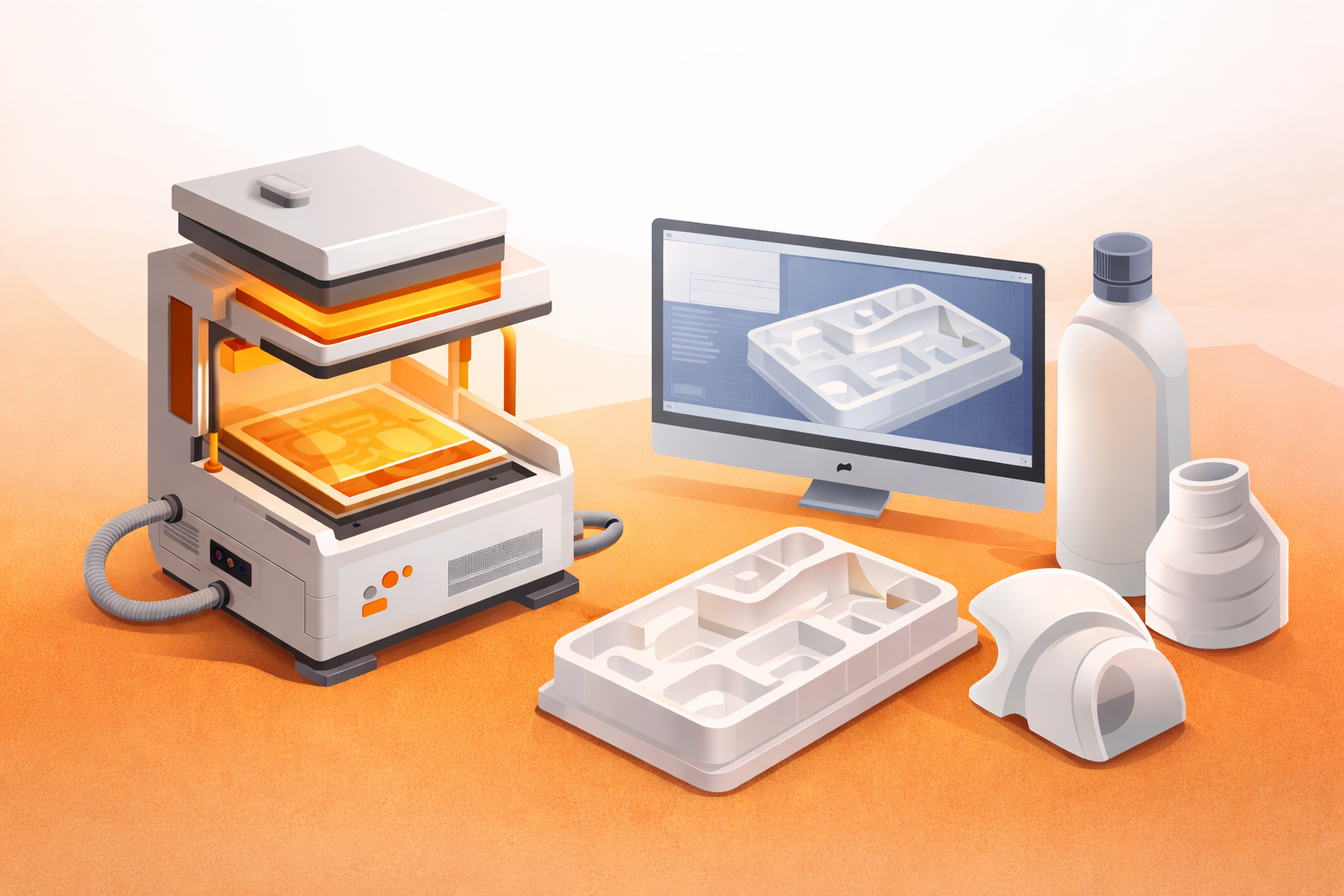
Thermoforming and vacuum forming continue to be essential manufacturing processes for producing lightweight, durable, and visually appealing products across many industries. From medical trays to automotive interior panels, thermoforming offers flexibility that other processes cannot match. Designers are increasingly choosing thermoformed components because the process adapts easily to different shapes, material thicknesses, and production volumes.
One of the strengths of thermoforming is the ability to create large surface-area parts at relatively low tooling cost. Unlike injection molding, which requires steel molds with complex cooling systems, thermoforming uses simpler aluminum tools, making it ideal for mid-volume production or large parts that would be too expensive to mold conventionally. This makes the process attractive for industrial equipment housings, appliance components, transportation interiors, and point-of-sale displays.
Material versatility is another advantage. Thermoforming supports ABS, HIPS, PETG, polycarbonate, acrylic, and many other sheet materials. Each offers different combinations of impact strength, clarity, chemical resistance, and heat tolerance. Multi-layer sheets can combine properties for specialized applications—such as scratch-resistant surfaces or UV-protected outdoor panels.
Modern forming equipment includes precise heating zones and programmable forming cycles. These features allow tighter control over temperature and forming pressure, resulting in parts with improved dimensional accuracy. Advanced vacuum pumps and pressure-forming systems improve draw quality and replicate fine detail on complex shapes. This is especially useful for automotive dashboards or covers that require a premium finish.
Digital design tools now help engineers predict thinning patterns, stress points, and cooling behavior before manufacturing begins. By simulating the forming process, designers can adjust sheet thickness or mold geometry to prevent weak areas or uneven distribution. This reduces trial-and-error time, shortens development cycles, and ensures consistent high-quality output.
Thermoforming also excels in customization. Quick tooling changeovers allow manufacturers to produce multiple design variations without extended downtime. This flexibility is ideal for industries where design updates occur frequently, such as consumer goods or commercial equipment.
In all, thermoforming and vacuum forming continue influencing modern product design by offering cost-effective tooling, material versatility, reliable aesthetics, and fast production cycles. These strengths make the process a dependable choice for many manufacturing applications today.